A wallet can show two amounts before you approve an Ethereum transaction: the value being transferred and an estimated network fee. Treating them as the same number makes it difficult to understand what will leave your account. This guide concerns Ethereum mainnet; other networks and exchange withdrawal services can calculate charges differently.
Value and execution cost answer different questions
The transfer value describes the ETH sent to the recipient. Gas measures the computational work of executing a transaction. A token transfer or a contract interaction may require different work from a simple ETH transfer. Sending a larger monetary amount does not, by itself, imply proportionally more computation.
A deliberately simple example
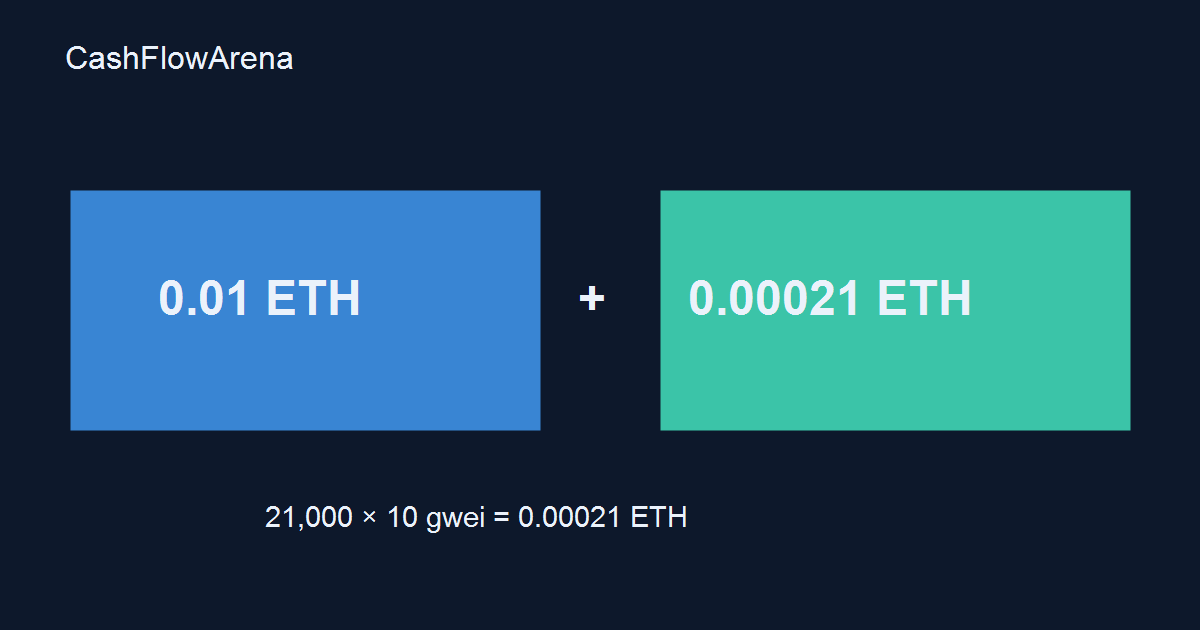
Suppose an operation uses 21,000 units of gas and its effective gas price is 10 gwei per unit. The execution fee is 210,000 gwei, or 0.00021 ETH. If the transfer value is 0.01 ETH, the combined amount is 0.01021 ETH in this simplified example. These are illustrative inputs, not a live quote or a guarantee that every transfer uses 21,000 gas.
The Ethereum gas documentation distinguishes the base fee, priority fee and maximum fee settings. The maximum fee is a cap; do not mistake it for the final effective price. A wallet estimate can change before inclusion, and fiat conversions add a separate price variable.
What happens if execution fails?
A transaction included in a block can fail during execution while still consuming gas. A failed contract operation therefore does not necessarily mean a zero fee. Conversely, a transaction that remains pending has not yet established a final execution result. Read the transaction receipt and actual gas used rather than inferring the outcome from a wallet notification.
A checklist before approval
- Confirm the network, asset and intended recipient.
- Separate the value transferred from the estimated network cost.
- Understand the action requested by the contract, especially approvals.
- Check the final receipt after inclusion and keep its transaction hash.
When comparing costs, compare the same action on the same network at the same time. An exchange withdrawal charge is not automatically the underlying on-chain fee. For account terminology, see our guide to wallet addresses and recovery credentials.
Next: check the transaction status in a block explorer.
Educational material prepared with AI assistance. Primary documentation checked on 29 October 2026; examples are illustrative.