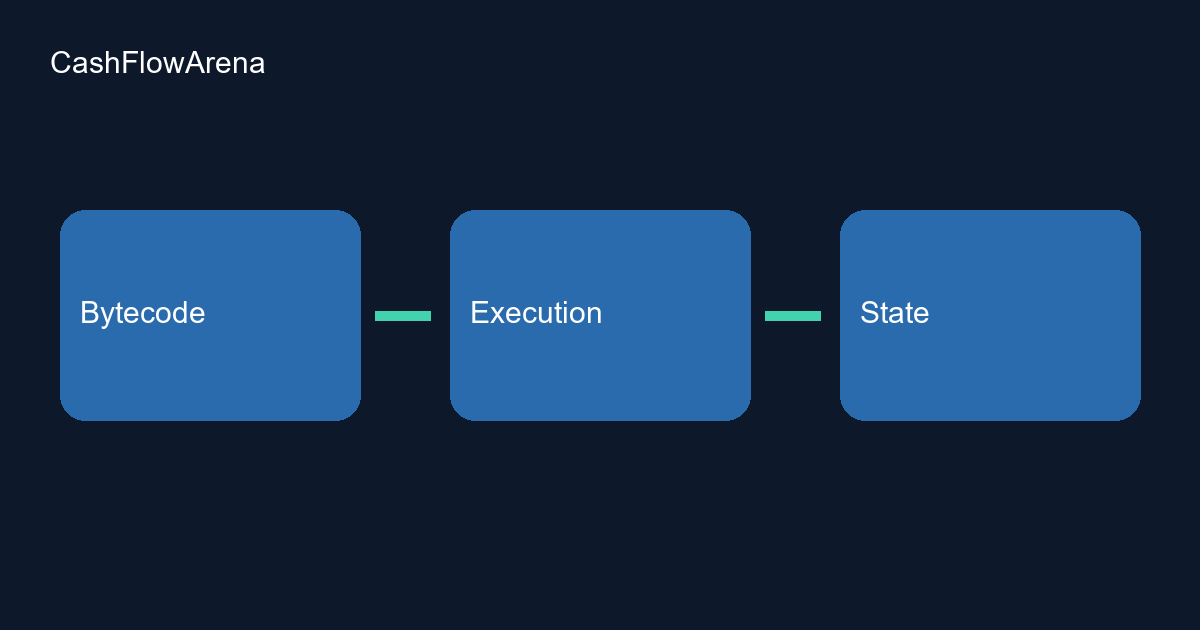
The Ethereum Virtual Machine, or EVM, is the execution environment used to run Ethereum smart contracts. To understand its role, follow three connected ideas: a contract contains compiled bytecode, the EVM executes that code as instructions, and Ethereum’s state changes according to defined rules. Gas measures the computational work and bounds how much a transaction can use.
This explains what contract execution involves without treating execution as a promise that an application will achieve its intended result. The useful questions are: which code runs, what stored information is involved, and what happens if the execution budget runs out?
What the Ethereum Virtual Machine executes
A helpful starting point is the distinction between a program and its execution environment. A smart contract supplies code; the EVM supplies the rules for executing it. Ethereum’s EVM documentation describes contract accounts containing compiled smart-contract bytecode. When another account makes a message call to a contract, that bytecode executes.
Bytecode is the compiled form of the contract program. It executes through EVM instructions called opcodes. You can think of bytecode as the encoded program and opcodes as the individual instructions through which its work is performed. Recognizing this relationship is more useful for a beginner than memorizing an instruction list.
For example, when reading a contract explanation, separate the intended behavior described in ordinary language from the compiled code that executes. Saying that a contract is intended to record a value describes its purpose. Explaining which instructions execute and which stored value results addresses its behavior.
The EVM is neither a wallet nor Ethereum’s consensus algorithm. Its role here is contract execution. Keeping that role clear prevents the phrase “the EVM processed it” from becoming an unsupported claim about everything surrounding an application interaction.
State transitions describe changes under rules
Ethereum’s state includes accounts, balances, and contract storage. The EVM defines the rules for changing state. The documentation expresses this relationship as Y(S, T) = S': a valid prior state, together with valid transactions, produces a valid resulting state under the transition rules.
Read this as a relationship between inputs, rules, and outputs. The prior state supplies the starting information. Transactions supply instructions to process. The transition rules determine the resulting state. Looking only at a contract’s stated purpose leaves out that starting context.
The documentation describes the transition function as deterministic: its output follows from its input under the defined rules. Deterministic does not mean guaranteed application success. Reproducibility and satisfaction of a person’s objective are different questions.
A limited deduction follows from two documented premises: state transitions follow protocol rules, and execution can exhaust its gas and have its changes reverted. Therefore, a valid state transition does not guarantee that a contract call achieves its intended result. This is an interpretation of those premises, rather than a separate promise made by the state-transition formula.
Contract storage is part of the state
A contract’s persistent storage is associated with its account and forms part of Ethereum’s global state. Conceptually, this is where a contract can retain information rather than merely calculate an intermediate result.
For a beginner, the key distinction is between executing instructions and establishing a persistent update. An explanation that mentions a storage-writing operation should still establish whether the intended update took effect. An attempted update alone is insufficient evidence of the resulting stored value.
Persistent storage also should not be confused with every piece of data used during execution. The EVM documentation distinguishes it from temporary execution data. You do not need the underlying storage-tree structure to understand the practical question: which information belongs to the contract’s persistent state, and what evidence establishes its resulting value?
Gas meters work and limits the execution budget
Gas measures the computational effort required to execute Ethereum operations. The transaction gas limit sets the maximum supplied gas budget for that transaction. These are related concepts: gas is the meter, while the limit bounds the budget available to the transaction.
A gas limit is not a price per unit of gas. This article focuses on computational budgeting rather than fee calculations or individual opcode prices. Supplying a budget also does not establish that the requested contract result will occur.
Insufficient intrinsic gas: rejected during validation
The Ethereum gas documentation distinguishes a transaction that lacks enough intrinsic gas to pass validation from one that runs out during execution. In the insufficient-intrinsic-gas case, the transaction is rejected before block inclusion, and no gas is consumed.
The source illustrates this with a simple ETH transfer whose gas limit is below its validation requirement. Its numerical example should not be generalized into a gas requirement for every contract operation. The important boundary is that validation rejects the transaction before execution proceeds.
Gas exhaustion after execution starts
In the source’s transaction-level out-of-gas case, execution begins but exhausts the supplied gas. The EVM reverts the execution changes, while all the gas provided is consumed for the work performed.
Keep that statement within its scope. It describes transaction-level gas exhaustion, rather than every possible execution failure. It does not establish asset recovery, reversal of gas consumption, or the treatment of failures inside individual internal calls.
A hypothetical stored-counter example
Hypothetical example: imagine a classroom contract whose persistent storage contains a counter at 7. Its intended operation is to increase the counter to 8. These values and the contract are invented for explanation; no live transaction is needed.
- Identify the program: the contract contains compiled bytecode that executes as EVM opcodes when called.
- Identify the starting state: the counter begins at 7 in the contract’s persistent storage.
- Identify the intended result: the classroom exercise expects a resulting counter value of 8.
- Consider the budget boundary: if the transaction exhausts its gas during execution, its execution changes are reverted and all supplied gas is consumed.
The hypothetical shows why describing the intended update is insufficient. You must distinguish the starting value, the executed operation, and the resulting stored value. In the gas-exhaustion alternative, the intended update is not established merely because execution started.
Separate execution from agreement, then check the explanation
Ethereum’s execution client executes transactions in the EVM. Its consensus client implements proof-of-stake agreement based on validated data from the execution client. The nodes and clients documentation establishes that division of responsibilities.
This is the conceptual boundary needed here: execution concerns processing instructions and state; consensus concerns network agreement using validated execution data. For the broader software roles, see Ethereum nodes and clients. For the separate stages involved in verification, see how an Ethereum transaction is verified.
Use this checklist when assessing an EVM explanation:
- Identify the compiled contract code and its intended operation.
- Specify the relevant starting state and persistent storage.
- Separate a rule-compliant transition from evidence of the intended result.
- Distinguish the transaction gas budget from a price per gas.
- Separate insufficient-intrinsic-gas rejection from gas exhaustion during execution.
- Keep execution and network agreement as distinct responsibilities.
These questions help interpret technical descriptions; source attribution alone does not establish that a particular contract is safe.
This educational article was prepared with AI assistance. Its example is hypothetical and does not ask you to submit a transaction or sign a wallet request.