A Solidity event declaration defines a named format for recording arguments. A log is a particular record produced through the Ethereum Virtual Machine’s logging mechanism. Understanding Ethereum logs vs events means separating that definition from an emitted record, then separating the record’s bytes from the interpretation assigned to them.
This distinction helps when an explorer displays a friendly event name beside hexadecimal topics and data. The name, decoded fields, and raw record answer different questions. A readable display is useful, but interpreting it requires the relevant event schema and context.
1. An event declaration defines the format
Solidity events provide an abstraction over EVM logging. Invoking an event records its arguments in the transaction’s log structure. A declaration describes what can be emitted; it is not evidence that a particular emission occurred. The Solidity contracts documentation explains this relationship and the information needed to interpret event data.
For example, a declaration can name an event Reading and specify two unsigned integer arguments. That establishes a format in the hypothetical program. To discuss an actual occurrence, you would need a particular emitted record.
If the distinction between program definitions and recorded activity is unfamiliar, our introduction to smart contract code, state, and calls provides background. Here, the focus is the event format and its resulting log.
2. Read the emitter, topics, and data separately
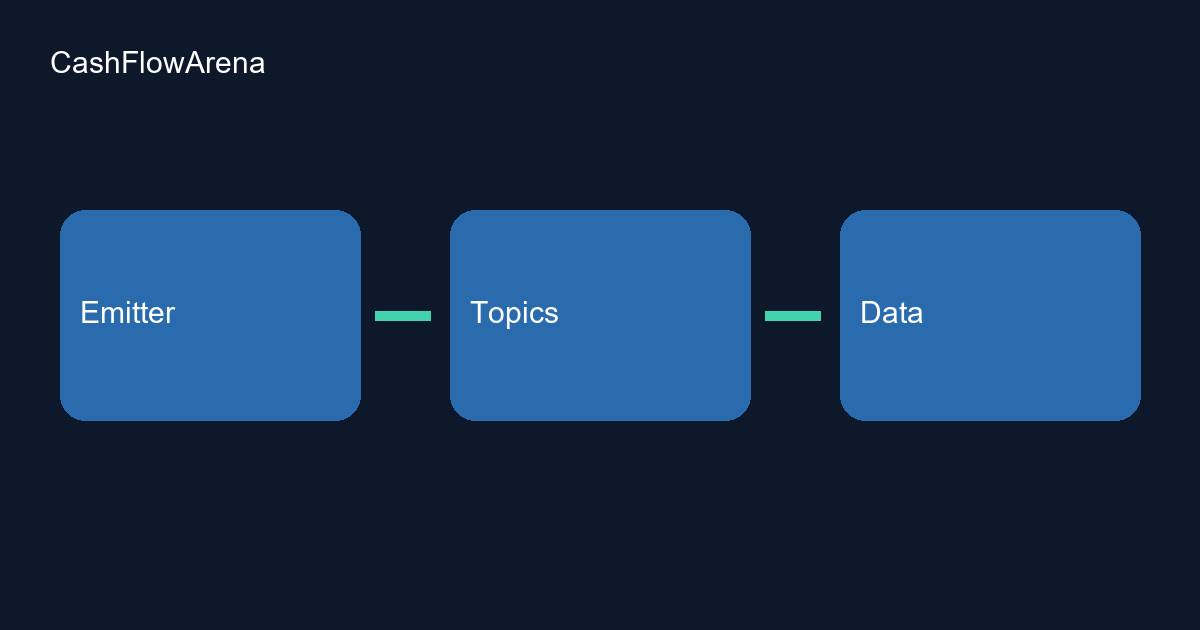
Three parts organize the record:
- Emitter: the log’s
addressfield identifies the address from which it originated. - Topics: an array containing zero to four entries, each 32 bytes long.
- Data: under Solidity event encoding, the byte sequence containing ABI-encoded non-indexed arguments.
The emitter field answers an origin question. Its presence alone does not identify the transaction sender or an economic recipient. Those would be additional interpretations requiring their own context.
Ethereum’s JSON-RPC documentation defines these log fields and illustrates an EVM-generated log included in a transaction receipt. That example demonstrates where a log can appear; it does not establish that every transaction produces one. A receipt is the surrounding transaction record, while the log is the particular item being interpreted here.
For background on the software supplying RPC information, see our explanation of Ethereum nodes and clients.
3. Topics follow the event’s encoding rules
For a non-anonymous event following the Solidity ABI convention, topics[0] contains the Keccak hash of the event name and its canonical parameter-type list. For an event named Reading with two uint256 parameters, that signature text is Reading(uint256,uint256). Parameter names and the indexed marker are absent from that signature formula.
Anonymous events omit this signature topic. Consequently, the first topic should not automatically be treated as an event identifier without establishing which convention applies.
An indexed uint256 argument is represented directly as a 32-byte ABI value in its argument topic. This direct-value rule must not be extended to every parameter type. Indexed arrays, including fixed-size arrays, strings, dynamic bytes, and structs instead use a Keccak hash of a special encoding. Dynamic bytes and fixed-size byte types should not be treated as interchangeable here.
As the Solidity ABI specification explains, the hashed representation supports matching known candidate values but does not let an application decode an unknown original value from that topic alone. Separately available information may help interpretation; it is additional evidence.
4. An ABI supplies the decoding context
Correct decoding requires the event’s type information, including which arguments are indexed and whether the event is anonymous. An ABI, or an equivalent event schema, supplies that context. The raw log does not store the event type as a complete description alongside its values.
This matters even when a decoding tool produces plausible field labels. A supplied schema tells the tool how to interpret the bytes. Successful interpretation under that schema does not independently verify that the schema belongs to the record being examined. That is a deduction from the distinction between recorded data and externally supplied type information.
There is a further limit to signature matching: Solidity documents that an anonymous event can imitate another event’s signature topic. Therefore, a matching topic alone does not authenticate the presumed declaration. This does not mean the emitter address has thereby been forged; origin and topic interpretation remain separate questions.
5. A hypothetical Reading record, decoded carefully
Hypothetical example: assume an invented contract emits a non-anonymous event declared as event Reading(uint256 indexed sensor, uint256 value); with arguments (7, 42). Assume the record follows that declaration’s Solidity ABI encoding. This is a teaching setup, not an observed transaction.
From those assumptions and the documented encoding rules, the record has the following interpretation:
addressidentifies the stipulated emitting contract’s address, which this example leaves unspecified.topics[0]holds the Keccak hash ofReading(uint256,uint256).topics[1]encodes the indexedsensorargument as the unsigned integer 7.dataencodes the sole non-indexedvalueargument as the unsigned integer 42.
The last two placements are deductions from the stipulated declaration: the signature occupies the first topic, the indexed argument occupies the next, and the non-indexed argument belongs in data.
Standard ABI unsigned integers use big-endian encoding, padded on the left with zero bytes to 32 bytes. Accordingly, the hypothetical sensor word ends in hexadecimal 07, and the data word ends in 2a, the hexadecimal representation of 42. Each word’s preceding bytes are zeros.
What does the number 42 establish?
Under the assumed schema, it establishes the decoded argument value. No physical unit, monetary unit, or payment operation was stipulated. It follows that this hypothetical record alone does not establish that a payment of 42 occurred.
This limit does not say that logs can never contribute evidence about economic activity. A stronger interpretation would require relevant contract behavior and execution context. For this exercise, decoding the argument and proving an economic outcome are distinct evidentiary steps.
6. A practical checklist for reading a log
- Separate definition from occurrence. Are you looking at an event declaration or a particular emitted record?
- Identify the emitter. Read the log’s address as its origin without assigning additional participant roles.
- Establish the schema. Identify argument types, indexed positions, and anonymous status.
- Check topic interpretation. Determine whether a signature topic is expected and whether argument topics contain direct values or hashes.
- Decode data under stated assumptions. Keep the raw bytes distinguishable from schema-derived labels and values.
- Limit the conclusion. Record what the example or evidence establishes, leaving unstated units and outcomes unresolved.
These checks can be used as a reading exercise with documentation and sample records. Source attribution supports the technical explanation; it does not certify a particular contract’s safety or prove an economic result.
This educational article was prepared with AI assistance. It explains record interpretation and does not recommend transactions or wallet signing.