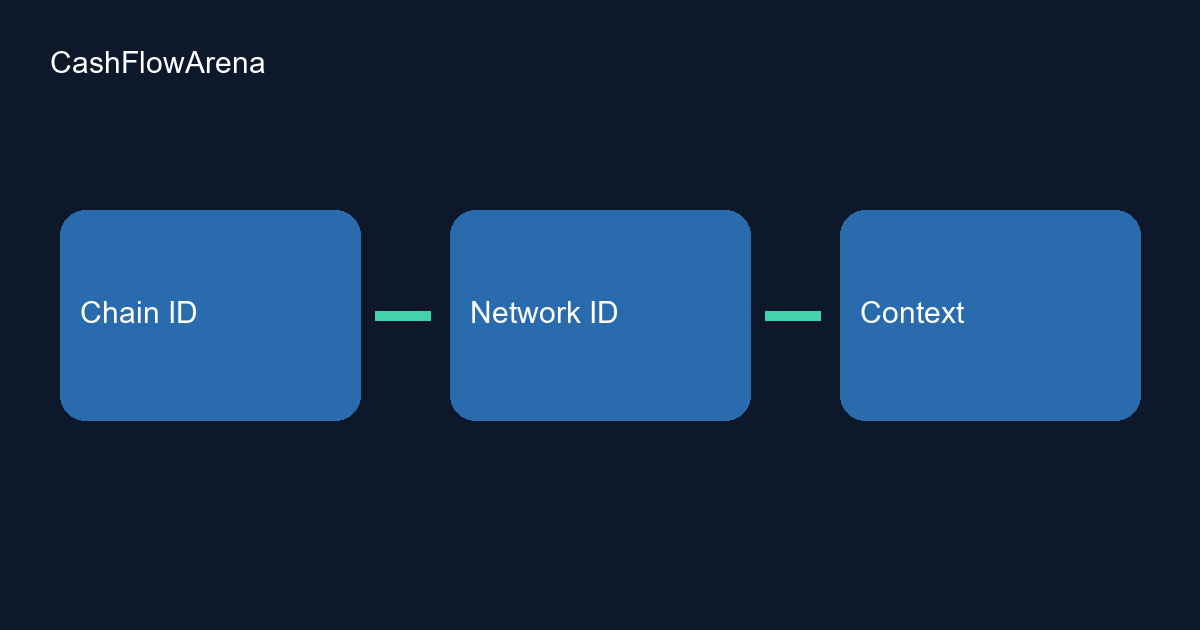
An Ethereum chain ID gives context that an address string alone cannot provide. The chain ID returned by eth_chainId is the configured value used in EIP-155 replay-protected transaction signing. The network identifier returned by net_version answers a separately defined question. Keeping those method names attached to their results prevents two different identifiers from becoming one unexplained number.
The useful reading habit is to separate three things: the address text, the identifier being reported, and the network context under discussion. This guide explains that distinction through documentation and a hypothetical example, followed by a checklist that requires no wallet signing.
Chain ID and network ID answer different questions
The Ethereum JSON-RPC documentation defines net_version as returning the current network identifier as a string. Preserve that meaning when recording its result: label it as a network ID returned by that method.
eth_chainId returns the currently configured chain ID associated with EIP-155 replay-protected transaction signing. These definitions give the two identifiers different roles. An explanation should therefore identify which method supplied a value before interpreting what the value means.
A numerical comparison does not replace those definitions. Even if an example records matching numbers, keep the two fields separate. Their documented purposes remain different; the comparison alone does not explain why those particular values were configured.
Read the representation and the response context
EIP-695 specifies a hexadecimal string representation for the integer returned by eth_chainId. For example, the notation 0x1 represents the integer one. When comparing recorded values, distinguish a difference in notation from a difference in the represented integer.
The proposal recommends preferring eth_chainId over net_version to identify the chain being communicated with. That recommendation assumes correct implementation. A citation to the specification does not authenticate a particular endpoint or establish that endpoint’s safety.
The response also has a defined context: the returned chain ID should correspond to information in the client’s current known head block. This is a requirement on implementation, rather than proof that any individual response satisfies it.
EIP-695 specifies an unsupported-method-style error if that head block does not specify a chain ID. Preserve the condition when explaining the error. An arbitrary failed request does not, by itself, establish that this particular condition occurred. For a reading exercise, leave an unexplained error unresolved instead of replacing it with a guessed identifier.
What chain IDs contribute to replay protection
EIP-155 describes a protected transaction hashing scheme that includes the chain ID. Its stated activation conditions are that the block number has reached the proposal’s activation threshold and that a chain ID is available. The point here is the chain ID’s place in that scheme, without working through transaction construction or signing.
The proposal also preserves the preexisting signature scheme using v values 27 and 28 under its previous rules. That compatibility statement should not be expanded into a claim about every chain’s or client’s present acceptance policy.
EIP-155 encourages adopting testnets, consortium chains and alternative Ethereum chains to choose unique chain IDs. Encouragement is not evidence that every independent chain actually follows it.
A bounded deduction follows from these premises: the protected scheme includes the chain ID, the older scheme remains available within the proposal, and adopters are encouraged to choose distinct IDs. Therefore, the chain-ID separation discussed here depends on using the protected scheme with different chain-ID values. Those premises do not establish the same protection for the preserved older scheme, chains sharing an ID, or every kind of signed request.
Why familiar address syntax does not identify a chain
The Ethereum accounts documentation describes an externally owned account address as a 20-byte value represented by 40 hexadecimal characters with an additional 0x prefix. That describes the address’s representation.
Separately, the Ethereum networks documentation explains that independent networks can conform to the protocol without interacting with each other. EIP-695 supplies the separately documented chain-identification method described above.
Combining those premises produces a logical inference: a hypothetical address string with the documented syntax cannot, by itself, establish chain identity. Its character pattern does not select among independent network contexts. This is a deduction from the sources, rather than a direct statement quoted from the accounts page.
The inference is limited to identification. It makes no claim about balances, deployments, funded status, private-key control or asset recovery across networks. Readers interested in a separate introduction to contract concepts can continue with smart contract code, state and addresses.
A hypothetical example with one repeated address
Imagine two invented documentation cards, A and B. Both display the address string 0x1111111111111111111111111111111111111111. Stipulate that card A records an eth_chainId result of 0x65, while card B records 0xca. These are fictional teaching inputs, with no assertion about live endpoints or deployed accounts.
The repeated address text supplies the same address representation on both cards. The stipulated chain-ID results supply different chain contexts. Following the earlier deduction, the address text alone cannot decide which card’s chain is intended.
Now cover the chain-ID fields. The address still has the same visible syntax, but the exercise has removed its explicit chain context. Restore the fields to make the distinction readable again. Nothing in this example assigns a balance, establishes a contract deployment or makes any claim about who controls an account.
A read-only identification checklist
- Name the intended context. Write down which chain the explanation concerns before interpreting an address.
- Preserve method labels. Record an existing
eth_chainIdresult as a chain ID and an existingnet_versionresult as a network ID. - Read hexadecimal notation correctly. Compare the represented integers rather than treating every textual difference as a different value.
- Retain response limits. Remember the current-known-head requirement and leave unexplained errors unresolved.
- Keep replay claims bounded. Identify the protected scheme and differing chain IDs before drawing the chain-ID separation conclusion.
- Keep address syntax in its role. Use it to discuss representation while retaining chain identity as a separate question.
This checklist can be applied to documentation or recorded responses. It calls for no transaction submission or wallet signature. Educational material prepared with AI assistance; the hypothetical example illustrates the documented distinctions.