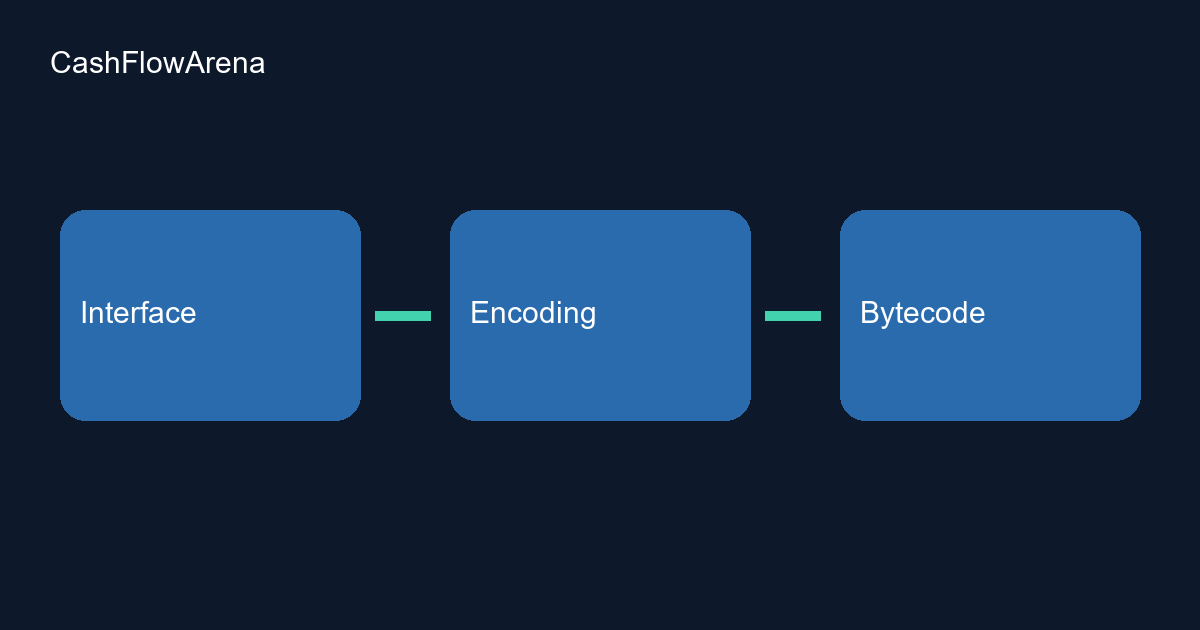
An Ethereum contract ABI is an interface description that helps applications encode function calls and interpret returned data. ABI stands for Application Binary Interface. The JSON artifact records information such as function names, parameter types and return types. It provides a structured description of the interface; assessing the implementation requires additional evidence.
The useful distinction is between what an interface declares, how its data is represented and what the executable program actually does. Understanding those roles makes an ABI easier to read without treating familiar function names or readable results as proof of safety.
ABI, source code and bytecode serve different roles
Ethereum’s compilation documentation describes the JSON ABI as a description of a deployed contract and its functions. It also explains that the Ethereum Virtual Machine needs bytecode to run a contract.
Source code enters the explanation before execution. In the Multiply7 example in Ethereum’s JSON-RPC documentation, a Solidity source contract is compiled into bytecode for the EVM. That example illustrates a compilation relationship; it does not verify the source of any other deployment.
From these premises, we can distinguish three representations:
- Source code: the program supplied for compilation in the example.
- Bytecode: the representation the EVM executes.
- JSON ABI: the interface description used to interpret functions and their typed data.
This distinction is a deduction from their documented roles. Possessing one representation does not, by itself, establish that it corresponds to the other two. In particular, finding an ABI file does not establish that it matches the deployment being discussed.
For broader background on the program itself, our guide to smart contract code, state and calls supplies the foundation. Here, the focus is the interface description.
What a function entry tells you
The Solidity ABI specification defines the fields in the JSON interface. For a named function, begin with three elements:
name: the function’s name.inputs: an ordered description of its parameters, with each parameter’s name and canonical type.outputs: a description of return parameters using objects similar to those ininputs.
Tuple parameters also use components to describe their constituent fields. An outputs array can be empty. These details matter because an interface description needs to preserve structure, rather than merely supply a list of recognizable words.
Do not assume every ABI entry follows the named-function pattern. Constructor, receive and fallback entries have no name or outputs; receive and fallback entries also have no inputs. The field expectations depend on the kind of entry being examined.
A declared output explains the expected return structure. It does not establish that an execution has occurred or produced a particular value. Keep the declaration separate from evidence of an actual result.
How names and types relate to a function selector
For an ordinary ABI function call, the selector is derived from the function’s canonical signature. The signature combines the function name with its parenthesized parameter types. The selector consists of the first four bytes of the Keccak-256 hash of that signature.
This is why recognizing a name is only part of understanding the interface. Parameter types belong to the canonical signature too. A comparison that checks the name but ignores the input types leaves out part of the information used to derive the selector.
Return types have a different role: they are excluded from the signature used to derive the selector, even though the full JSON description includes outputs. Consequently, a selector does not supply the return schema by itself. This conclusion follows from the documented separation between selector derivation and output description.
The selector relationship explains interface interpretation. It does not establish that a selector identifies a safe implementation, and it should not be treated as a security verdict.
Why encoding and decoding depend on a schema
ABI encoding follows the types of the values being encoded. The specification explicitly describes the encoding as not self-describing: decoding requires a schema. In this context, a schema supplies the structure and types needed to interpret the data.
That creates two distinct reading tasks. First, identify the declared types and structure. Second, establish why that description is appropriate for the data under discussion. Supplying an ABI answers the first task only to the extent that the file contains the relevant description; its correspondence to a deployment remains a separate question.
Function return values are combined into a tuple and ABI-encoded together. The outputs description therefore matters when interpreting returned data, even though return types do not participate in selector derivation.
A readable interpretation should remain conditional on the schema being appropriate. The logical limit is straightforward: because decoding depends on a supplied description, interpreting bytes using that description does not independently verify the executable implementation.
A hypothetical interface reading exercise
Imagine a fictional classroom contract with a named function called lookupRecord. Its hypothetical ABI declares one input named recordId with type uint256, and two outputs named found and label, with types bool and string. This is an invented example, not a deployed contract or an instruction to interact with one.
The interface lets a student identify the function name, the input type and the two-part return structure. Its canonical signature would be lookupRecord(uint256). The declared output types would not appear in that selector signature.
Now suppose the worksheet provides only this interface and asks what label the function returns for record 7. The supported answer is that the result is not established. The declaration supplies a return schema, but the exercise supplies neither implementation behavior nor an execution result.
Likewise, a student cannot conclude from the name that the function searches a particular database, applies a particular rule or produces accurate information. This is a deduction about the exercise’s limited evidence. Additional implementation and result evidence would be needed to support those conclusions.
A checklist for interpreting an ABI without overclaiming
- Identify the artifact: distinguish the JSON interface from source code and executable bytecode.
- Check correspondence: ask what evidence connects the supplied ABI to the deployment under discussion.
- Read the entry kind: apply the named-function fields only where appropriate.
- Preserve input structure: record names, canonical types, order and tuple components where present.
- Read outputs separately: distinguish declared return structure from an observed result.
- Keep selector derivation precise: use the canonical name-and-input-type signature; exclude return types.
- State decoding assumptions: identify the schema on which an interpretation depends.
- Bound the conclusion: interface interpretation alone does not prove implementation safety.
That final limit is a deduction from the ABI’s descriptive role, the schema dependency of decoding and bytecode’s executable role. It is not a finding that a particular contract is unsafe. Documentation links establish the basis for this explanation; they do not certify a deployment.
This educational article was prepared with AI assistance. The hypothetical exercise is for understanding interfaces, not a recommendation to submit a transaction or sign a wallet request.