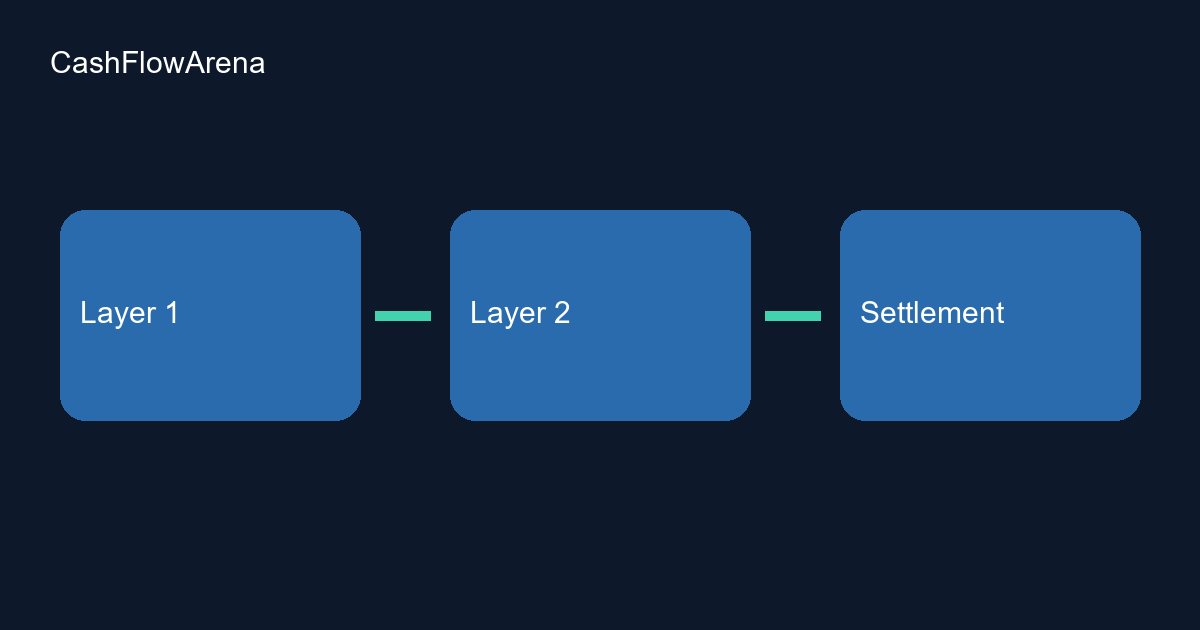
In Ethereum, layer 1 is Ethereum Mainnet. Layer 2 refers to solutions that handle transactions away from Mainnet while deriving security from it. The useful distinction is where work happens and how the additional network relates to Ethereum—not simply which network advertises faster or cheaper activity.
Understanding layer 1 vs layer 2 becomes easier when you separate three questions: Where are transactions processed? Where is their data posted? What security assumptions does the particular network introduce? Those questions help explain rollups, distinguish sidechains, and keep a broad architecture label from becoming an unsupported safety promise.
1. Mainnet is layer 1; settlement describes a role
Ethereum Mainnet is the layer 1 network in this explanation. Ethereum also serves as a settlement layer for networks built upon it. These descriptions concern its position and role within the architecture.
Settlement is not a separate third network in this comparison. Calling Ethereum a settlement layer describes a function it performs for other networks. It does not, by itself, establish a completion time, a withdrawal schedule, or a guarantee about a particular operation.
Keep that distinction in mind when reading diagrams. A box labeled Layer 1 and another labeled Settlement can represent different aspects of Ethereum’s role rather than two independent blockchains. The relevant question is what each label means in the accompanying explanation.
2. Onchain and offchain describe different scaling approaches
Ethereum’s scaling documentation distinguishes onchain scaling from offchain scaling. Onchain scaling requires changes to Ethereum’s layer 1 protocol. Offchain scaling solutions are implemented separately from Mainnet without requiring changes to the existing Ethereum protocol.
The distinction concerns how the scaling approach is implemented. A change to Mainnet’s protocol belongs to the onchain category. A separate system handling activity outside Mainnet belongs to the offchain category described by the source.
However, offchain is broader than layer 2. Under this documentation’s narrower classification, layer 2 derives security from Ethereum Mainnet. Other offchain approaches can have a different security relationship.
A deduction follows from those definitions: knowing that a network processes activity outside Mainnet is insufficient to classify it as layer 2. You also need evidence about its security relationship with Mainnet. Separate implementation alone does not answer that second question.
3. Layer 2 separates transaction handling from Mainnet
Layer 2 solutions handle transactions off Ethereum Mainnet while deriving security from Mainnet. This explains how processing can take place elsewhere without making Ethereum irrelevant to the design.
Two statements therefore need to remain separate:
- Transaction handling: the layer 2 processes transactions away from Mainnet.
- Security relationship: the layer 2 derives security from Mainnet under the source’s classification.
The second statement does not establish identical overall guarantees for every implementation. It identifies an architectural relationship. Assessing a particular network still requires examining its technology, smart contracts, and maturity.
For additional Ethereum background, see our separate introduction to Ethereum nodes and clients. This guide stays focused on the layer 1 versus layer 2 comparison.
4. Rollups connect offchain execution with layer 1 data
Rollups execute transactions outside layer 1 and then post transaction data to layer 1. Execution location and data location are therefore separate parts of the explanation.
This answers a common conceptual difficulty: processing transactions outside Ethereum Mainnet does not necessarily mean keeping their transaction data outside it. A rollup combines offchain execution with posting transaction data to layer 1. That statement does not specify permanent data retention or explain the mechanisms used to establish transaction correctness.
Ethereum’s introduction to layer 2 networks presents data location as one useful perspective for classifying a network’s relationship to Ethereum. Ask whether the network stores its data on Ethereum Mainnet, rather than relying only on its promotional description.
Data location is a classification question, not a complete safety assessment. From the separate requirements for assessing technology, contracts, and maturity, it follows that a data-location answer alone cannot establish all of those factors.
Why sidechains require a separate description
Under the scaling documentation’s classification, sidechains derive their security separately from Mainnet. They should not automatically be grouped into the Mainnet-security-derived layer 2 category simply because they are discussed alongside Ethereum scaling approaches.
That distinction makes no universal judgment about sidechain safety. It also does not establish where a particular sidechain stores its data. Security relationship and data location should be recorded separately rather than inferred from one another.
5. A hypothetical comparison of two network descriptions
Hypothetical example: Elena is preparing an educational comparison using two invented documentation summaries. Neither describes a real product or a network recommendation.
Network A is stipulated to execute transactions outside Mainnet, post transaction data to Mainnet, and derive security from Mainnet. Its description leaves contract security and network maturity unassessed.
Network B is stipulated to execute transactions outside Mainnet, store its data elsewhere, and derive security separately from Mainnet. Its contract security and maturity are also unassessed.
From those stipulated premises, Elena can draw a limited conclusion: Network A matches the execution-and-data relationship described for rollups and the security relationship described for layer 2. Network B does not match that narrower layer 2 security classification.
She cannot infer that Network A has identical overall guarantees to Mainnet, or that Network B is necessarily unsafe. Neither description supplies the missing network-specific assessment. These are deductions from the invented descriptions, not independently verified findings about any actual network.
The example shows why a useful comparison records both established information and gaps. A clear classification can coexist with an unresolved safety assessment.
6. A checklist for reading layer 1 and layer 2 explanations
Use this checklist when comparing technical descriptions, without making a transaction or signing a wallet request:
- Identify the base network. Confirm that layer 1 means Ethereum Mainnet in the explanation.
- Locate transaction handling. Does execution happen on Mainnet or outside it?
- Locate transaction data. Does the description establish that data is posted to Mainnet, or stored elsewhere? Leave missing information unresolved.
- Identify the security relationship. Does the network derive security from Mainnet or separately from it?
- Separate classification from assessment. Examine what evidence addresses technology, smart contract security, and maturity.
- Preserve the limits. Do not turn a layer label or documentation link into a promise about safety, timing, or recovery.
The supplied Ethereum documentation identifies technology, smart contract security, and maturity as factors affecting network safety. It does not provide a universal maturity threshold or certify an individual network through its layer label. Unresolved network-specific judgments need further editorial review.
This educational article was prepared with AI assistance. It explains architectural roles and does not provide financial advice or instructions to move funds.