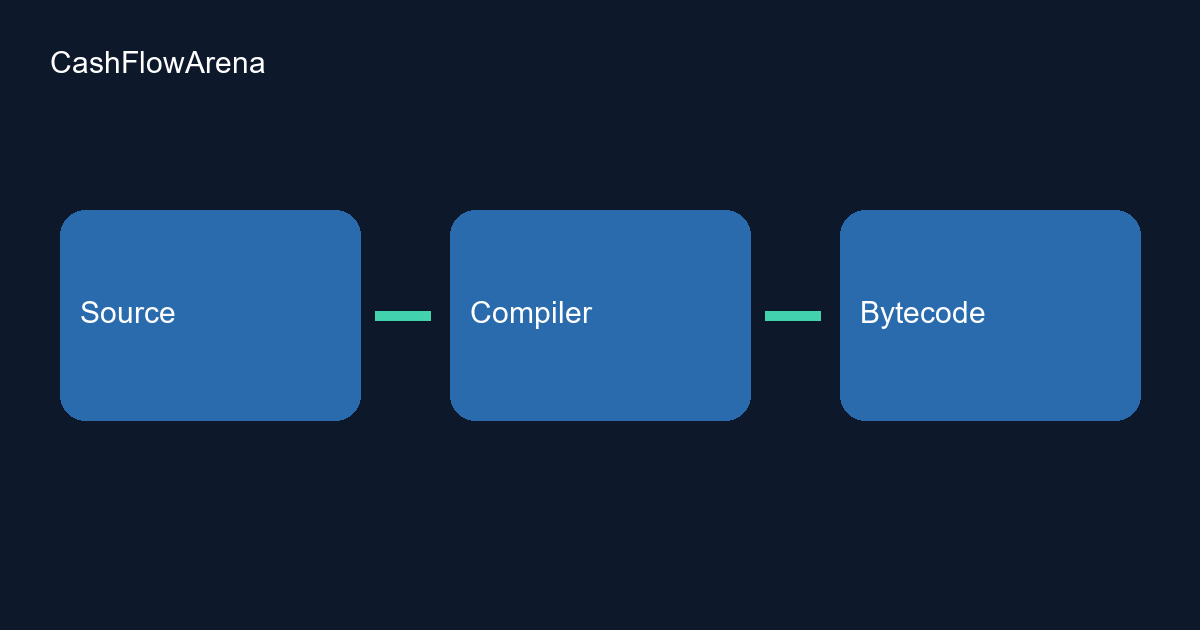
Ethereum contract verification connects readable source code with the bytecode at a particular contract address. Its central question is whether the supplied source and compilation inputs reproduce the code being compared. A successful match provides evidence about that relationship. Correctness, independent auditing and safety require different evidence.
To interpret a verified label, look beyond the label itself: identify the address, the compilation inputs and the kind of match reported. This article explains those distinctions and offers a checklist for reading existing evidence.
Source code and deployed bytecode
Developers write smart contract source in a high-level language such as Solidity. They compile that source into bytecode so the Ethereum Virtual Machine can execute the contract logic. Source code and bytecode therefore describe related stages of the program, with different uses for a reader.
Source verification checks whether given source code compiles to the bytecode executed at the identified contract address. That address matters: the verification claim concerns a particular comparison target, rather than every contract carrying a similar name or description.
The practical benefit is readability. Verified source makes it easier to investigate behavior through a high-level language instead of reading machine instructions. That creates an opportunity for examination; it does not establish that anyone has completed a security assessment. These distinctions follow the supplied Ethereum documentation on source code verification.
What reproducible matching establishes
Compilation is deterministic when the same source files and compilation settings are used. Relevant settings include the compiler version and optimizer configuration. Reproducibility therefore depends on the inputs together, rather than on a source listing considered in isolation.
A matching result connects those inputs to the compared bytecode. When reading a verification record, ask which source files and settings the result describes. A compiler name alone leaves that account incomplete.
There is also a limit to the simple explanation. Ethereum’s documentation explicitly describes recompiling and comparing as a simplification, with exceptions including immutable variables. This article does not explain how verification software handles those cases. A mismatch in an actual case would require examining its details; this simplified account cannot diagnose it.
The appropriate conclusion is bounded: the reported inputs matched under the documented comparison method. Whether the evidence also establishes exact source-file identity depends on how metadata was treated.
Full and partial matches answer different questions
Some source differences, including comments and variable names, can leave compiled bytecode unchanged. Consequently, different source files can verify against the same contract bytecode when those differences do not affect the comparison. A readable comment should therefore be assessed as an explanation, without treating an ordinary bytecode match as proof that the comment appeared in the original source.
The documentation describes a stronger identity check using the metadata hash appended to contract bytecode. When both the bytecode and that metadata hash match the supplied source and compilation settings, the described full-verification method establishes exact source identity, down to the source bytes.
That conclusion is conditional on the required comparison actually matching. If metadata hashes differ or are left out of verification, the supplied documentation calls the result a partial match. Preserve the reported category when describing the evidence. If the record does not explain metadata treatment, leave the strength of source identity unresolved.
Even exact source identity remains an identity result. It does not turn the source’s behavior into evidence of correctness or safety.
Why verified does not establish audited or safe
An audit is a form of independent code review. Formal verification evaluates correctness against specified properties through a formal model and specification. Both address questions beyond whether source reproduces bytecode, and formal conclusions remain bounded by the properties, specification and model involved.
Audits have limits too. The Ethereum smart contract security guide explains that audits do not catch every bug. Evidence that a review happened should therefore retain its limits rather than becoming a general safety guarantee.
The resulting deduction is explicit: because source matching establishes correspondence, while audits and formal methods assess different questions, a source verification result alone establishes neither an audit nor correctness or safety. This does not mean that a verified contract is necessarily unsafe, incorrect or unaudited. It means those conclusions need their own evidence.
For a related reading exercise about evaluating a different part of an application’s description, see our explanation of blockchain oracles and external data feeds.
A hypothetical comparison of two records
Imagine a classroom worksheet with two fictional verification records for one invented contract address. Record A identifies source files, compiler settings and a bytecode match, but says metadata was excluded. Record B identifies its source files and settings and reports that both bytecode and the appended metadata hash matched. These are stipulated teaching inputs, not observations about a deployed contract.
Using the documentation’s terminology, Record A describes a partial match. Record B describes a full match under the stated method. The difference concerns the strength of source identity: Record B supplies the metadata-aware comparison needed for the exact-source conclusion.
Now suppose neither record includes evidence of independent code review. The deduction is that an audit remains unestablished by these records. It would be equally unsupported to declare that no audit ever occurred. The worksheet illustrates how to preserve a gap in evidence without replacing it with either reassurance or an accusation.
A read-only evidence checklist
The following checklist is an editorial deduction from the comparison requirements and the separate role of security review. Use it to organize existing records and documentation.
- Identify the target. Record the contract address to which the verification result applies.
- Identify the inputs. Note the source files and compilation settings, including the stated compiler version and optimizer configuration.
- Read the result. Distinguish an explicitly reported match from a source listing whose comparison result is unspecified.
- Preserve the match category. Record whether metadata hashes matched, differed or were excluded. Keep an unexplained category unresolved.
- Separate security evidence. Record independent review or formal analysis separately, retaining the scope and limits of any documented conclusions.
- Write only the supported conclusion. Describe what matched and what remains unestablished. Completing this checklist does not certify safety.
If the evidence needed for a conclusion is missing, that conclusion remains open for further review. A useful explanation makes the boundary visible instead of letting the word verified carry more meaning than the record supports.
Educational material prepared with AI assistance using the supplied primary documentation. The fictional example illustrates evidence interpretation.