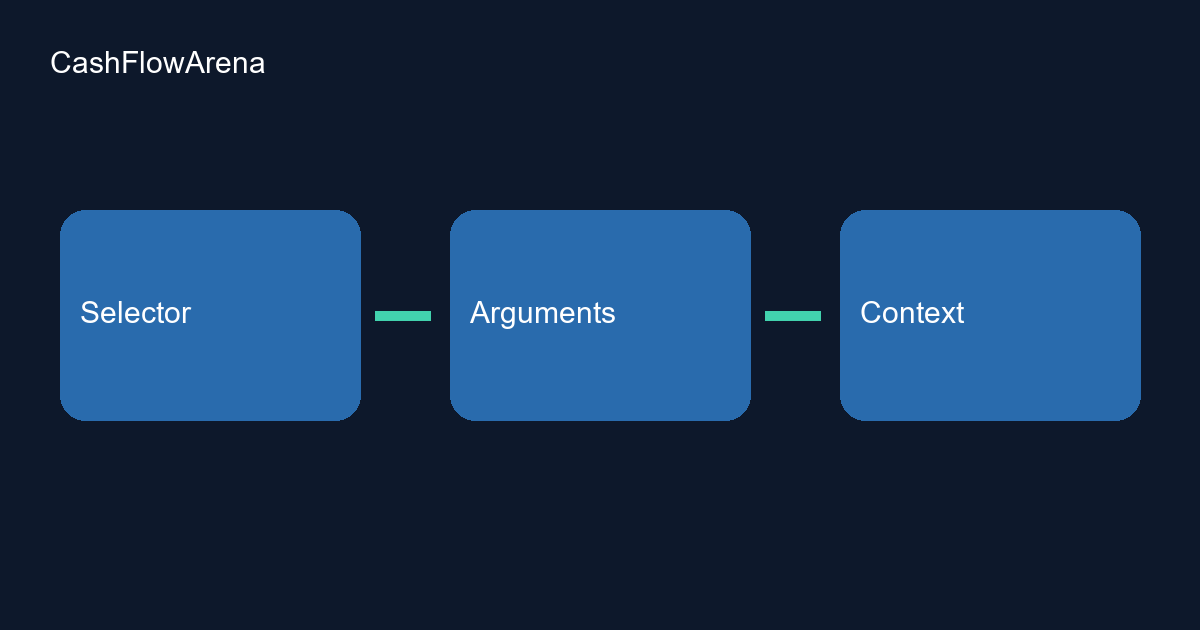
Ethereum transaction input data is an optional field that can contain arbitrary data. For a standard ABI function call, those bytes have a recognizable structure: a function selector followed by encoded arguments. Interpreting that structure requires the relevant interface schema.
The useful reading task is to separate three questions: what bytes are present, how a particular schema interprets them, and which conclusions remain unestablished. Empty input, a recognizable selector, and a decoded number each answer only part of that task.
What the input field contains
The Ethereum transaction documentation describes input data as optional and able to contain arbitrary data. That broad definition matters: the field does not require every possible input to follow the ABI function-call convention. Begin with the bytes actually provided before assigning a function name or argument type.
For byte-array data, Ethereum JSON-RPC uses hexadecimal text prefixed with 0x, with two hexadecimal digits representing each byte. The JSON-RPC encoding conventions distinguish this DATA representation from the formatting used for numeric quantities. Keep that distinction when reading an input field.
In the byte-array representation, 0x means an empty sequence: there are no data bytes after the prefix. It is not the encoding of the numeric quantity zero. Describe this as empty input rather than treating it as a number waiting to be decoded.
How selectors and arguments fit together
The Solidity Contract ABI Specification places the function selector in the first four bytes of standard function-call calldata. Encoded arguments follow from the fifth byte when arguments are present. This layout does not imply that every function requires arguments, and it does not describe every arbitrary input sequence.
The selector is the first four bytes of the Keccak-256 hash of the function’s canonical signature. That signature uses the function name followed by parenthesized parameter types, separated by commas without spaces. The types must use their canonical ABI representations; the particular argument values are not part of that signature.
For an invented classroom function with one uint256 parameter, suppose its canonical signature is record(uint256). The signature identifies the function name and parameter type in this exercise. A particular value, such as 6, belongs to the encoded argument region. No selector value is calculated or asserted for this fictional function here.
When annotating a standard ABI call, label the selector and argument region separately. This keeps the interface description beside the bytes it is being used to interpret. For background on the program being addressed, see our guide to smart contract code, state, and calls.
Why the ABI schema is needed
ABI encoding is not self-describing. Decoding requires a schema that supplies the relevant structure and types. A suitable contract ABI provides that information, although a particular JSON file is not the only way to represent the required type knowledge.
This requirement is easy to overlook when a tool displays a familiar function name. Ethereum’s transaction documentation illustrates selector ambiguity with 0xa9059cbb: its discussion identifies several known candidate functions for that selector. The example supports the possibility of multiple candidates. It does not establish that every selector has multiple known matches.
A selector lookup therefore needs to remain a candidate identification step unless the destination contract’s interface is established. For a reading exercise, write down where the schema comes from. If it is merely stipulated, keep that assumption visible. If it remains unknown, leave the type interpretation unresolved instead of presenting a plausible label as established.
A hypothetical argument that decodes to 6
Consider a hypothetical worksheet with three explicit assumptions: the input is correctly formed standard ABI calldata, its selector is correct for the intended function, and the function has exactly one uint256 argument. After the four selector bytes, the worksheet supplies this argument word:
0000000000000000000000000000000000000000000000000000000000000006
The word contains 31 zero bytes followed by 06. Standard ABI encoding represents supported unsigned integers as 32-byte big-endian values, padded on the left with zero bytes. This rule applies to those integer types in standard ABI encoding; it is not a general decoding rule for every data type or arbitrary transaction input.
The deduction is conditional: the stipulated schema identifies the post-selector word as a uint256, and the unsigned-integer encoding rule then yields the integer 6. The argument position, schema, and encoding rule together support that interpretation.
Now remove the schema from the worksheet. Because the encoding is not self-describing, the word ending in 06 cannot by itself establish that its type is uint256. Additional interface evidence could establish the type, but the bytes alone do not supply that missing premise. The example also does not establish that any real transaction occurred or executed.
What empty input does and does not establish
Empty input contains zero bytes, while a standard ABI selector requires four bytes. From those two premises, we can deduce that empty input contains no standard ABI function selector. This is a conclusion about the available bytes. It does not classify the destination account.
Ethereum’s transaction documentation separately describes a transaction directed to a contract account as executing contract code. That general statement does not identify a particular handling path or establish successful execution.
For a second hypothetical exercise, stipulate a contract-account destination and empty input. The absence of selector bytes and the contract-destination rule can both apply. The resulting deduction is limited: having no selector does not imply that no contract code executes. Determining the particular handling path or outcome would require further evidence.
A checklist for reading input data
- Identify the representation. Read the field as byte-array DATA, keeping numeric quantity formatting separate.
- Check whether it is empty. Record
0xas zero input bytes without assigning a destination type or execution outcome. - Establish the encoding convention. Apply the selector-and-arguments layout only when standard ABI function-call encoding is the relevant assumption.
- Record the schema. Identify the interface evidence or clearly state the hypothetical parameter types.
- Keep candidate names qualified. A selector lookup can be ambiguous and does not alone establish the destination interface.
- Explain each deduction. Connect a decoded value to its argument position, type schema, and encoding rule.
Use these questions to keep a reading of the bytes precise. The checklist organizes interpretation; it does not certify a contract’s safety. Source attribution identifies the basis for the explanation without establishing the safety of a particular interaction.
This educational article was prepared with AI assistance. Its hypothetical examples explain input decoding and do not recommend financial action.