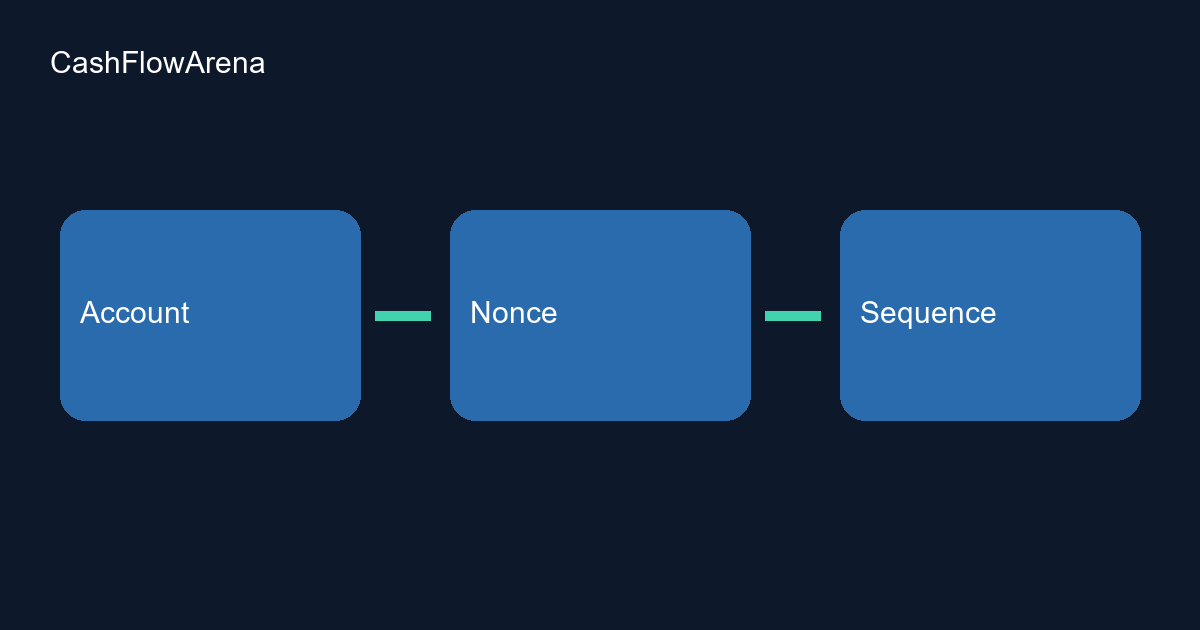
An Ethereum account transaction nonce is a counter used in the sending account’s transaction sequence. In ordinary externally-owned-account flow, it counts transactions sent from that account, while the nonce carried by a transaction identifies its position in that sequence. That gives a blockchain nonce a concrete meaning in this context: an account transaction number.
Two details make the explanation more useful. First, the account sequence has a one-time execution rule for each nonce. Second, a transaction count obtained through an RPC request comes with an address and a selected block context. Understanding those details also helps separate the account nonce from the block nonce discussed in historical Ethereum mining material.
What an account transaction nonce describes
This guide concerns ordinary transactions from externally-owned accounts, commonly abbreviated as EOAs. The Ethereum account documentation describes the nonce in that setting as a counter of transactions sent from the account. Keep that scope attached to the definition: it is not a universal explanation of every account type or every possible reason an account nonce might change.
The Ethereum transaction documentation describes the transaction’s nonce as a sequentially incrementing counter indicating the transaction number from the account. These descriptions address related views of the same ordinary transaction flow: the account has a counter, and a transaction carries a sequence number.
When reading an explanation, look for the sending account alongside the number. A bare statement such as nonce 12 omits the account whose sequence is being discussed. Keep the account reference visible throughout an example so that the transaction number retains its context.
Sequence and one-time execution
The incrementing sequence gives ordinary EOA transactions their account-specific numbering. Ethereum’s account documentation also states that only one transaction with a given nonce can be executed for each account. It connects that rule to protection against replay attacks involving repeated broadcasting and execution of a signed transaction.
Read this as a bounded statement about the account’s transaction sequence. It does not establish cross-network replay protection, explain competing chain histories, or show whether a particular transaction’s intended operation succeeded. Those are separate questions that this nonce explanation does not resolve.
The supplied evidence also does not describe a transaction pool’s admission or rejection algorithm. Accordingly, the sequence rule should not be expanded into claims about exactly when software rejects, retains, replaces, or schedules a submitted transaction. Understanding the counter does not require inventing those implementation details.
A hypothetical sequence
Imagine an educational record for Account A containing three ordinary transactions numbered 12, 13, and 14. These invented numbers illustrate the incrementing sequence described by the transaction documentation. They are not a live account history or instructions for submitting transactions.
Now imagine the signed transaction numbered 13 being broadcast again. Within Account A’s sequence, the documented one-time rule means that rebroadcasting does not enable repeated execution using that same nonce. The example illustrates the rule; it makes no prediction about a particular application’s messages or treatment of the rebroadcast.
What eth_getTransactionCount asks for
The method eth_getTransactionCount returns the number of transactions sent from an address. Its request includes the address and a block parameter. The Ethereum JSON-RPC documentation lists a block number or a tag as accepted choices for that parameter.
Those tags include latest and pending, alongside other documented selections. In the supplied example, latest is explicitly described as the state at the latest block. Thus, an account count should be recorded with the selection used to request it.
This last point is a deduction from the method description and parameters: because the request identifies both an address and a block context, both belong in the interpretation of the returned count. The documentation does not need to promise different numerical answers for every pair of selections for that context to matter.
For a hypothetical reading exercise, write two request labels: Account A with latest, and Account A with pending. Leave their results blank. Even before adding numbers, the labels show which question each request asks. Any later explanation of the results should preserve those labels rather than presenting two unexplained counts.
What the pending tag does not establish here
The supplied method excerpt confirms that pending is an accepted block tag. It does not define how pending state is constructed or establish that the returned value includes every pending transaction across the network. This article therefore gives no pending-pool completeness guarantee.
That is an evidence limit, not a claim about a particular provider’s implementation. A stronger explanation of what a specific pending result includes would require additional primary documentation and editorial review. The listed tag alone cannot support that stronger explanation.
Similarly, this guide does not claim that latest and pending must produce different counts, or that subtracting their results establishes a complete inventory of pending transactions. Keep the supported point narrower: the count is requested for an address with a specified block parameter.
How this differs from the historical mining nonce
Ethereum’s historical proof-of-work documentation describes miners using trial and error to find a nonce for a block. It also explains that Ethereum switched from proof of work to proof of stake in 2022. The mining description is historical.
The distinction between these nonce roles follows from two documented premises. The ordinary EOA transaction nonce identifies a position in an account sequence; the historical mining nonce was a searched-for block value. Comparing those roles establishes that they serve different purposes. This comparison is a deduction from the sources, rather than a quotation from either one.
When encountering the phrase blockchain nonce, first identify which object the explanation concerns. Here, the focus is the account transaction sequence. Historical mining explanations concern the block search described above, and should retain their historical context.
A checklist for reading a nonce explanation
- Identify the sending account and keep the explanation within ordinary EOA transaction flow.
- Read the transaction nonce as its position in that account’s incrementing sequence.
- Apply the one-time execution rule within that sequence without extending it into unsupported replay or finality claims.
- For an RPC count, record the address and the requested block number or tag.
- Treat pending-pool completeness as unestablished by the supplied excerpt.
- Check whether a mining reference describes Ethereum’s historical proof-of-work system.
For a separate explanation of transaction records, see how to read an Ethereum transaction in a block explorer. The scope here remains the account counter, its sequence role, and the context of an RPC count.
Educational material prepared with AI assistance. The explanation uses the supplied Ethereum documentation; its evidence mappings remain candidates for independent editorial review.